Monday, 25 May 2020

The Search for the Elusive Slowbohms

My great, great grandfather and his father had the middle name 'Slobourn', but where had this name come from? In 1994 I purchased the marriage certificate of my 3 x great grandparents, Joseph Slobourn Williams and Harriett Barnett who were married in Beechworth in 1860. On this certificate Joseph stated his mother was Ann Slobourn. Joseph, it appeared, had been given this middle name as it was his mother's maiden name, a quite common tradition and he had then carried it on to his son. Joseph signed his full name on his marriage certificate, with his middle name spelt 'Slobourn' and this was one of many spelling variations I have come across.

It is often assumed the less common the surname the easier it will be to trace the family. Even Ancestry advertisements imply all you need to do is type in a name and all will be revealed! This certainly didn't happen in this case. Joseph had also stated that he was born in Wales. A Williams in Wales is going to the other extreme, but at least his father had married a Slobourn, so I thought I might have some hope of finding their marriage. No such luck! Census records drew a blank, I just had too little information with such a common name as Williams. Then one day in 2009 as a last resort I typed Slobourn in Google and up came the name Mabel Sloburn Williams in a family group sheet on the Ballarat Genealogy site. She was a daughter of a Thomas Williams, a carpenter, born in London. It was a reasonable assumption to think that Thomas and Joseph were brothers. I now had that little extra information to try the census records again and finally found the family living in St Pancras in 1841. It also showed Ann and the children had not been born in the county, so perhaps Joseph had been born in Wales.

Another few years passed until I received an email from a second cousin, who after much patience had found the marriage of Ann Slowbohm and Joseph Williams in St Pancras in 1821 on Pallot's Marriage Index. Ann's surname had been written and transcribed as 'Horobohm' despite the index having (?Slowbohm) next to the name. Finally the marriage and the first appearance of this spelling of the name. I then went searching for Slowbohms and found a few living in Whitechapel and although I could not link them to the family I felt there must be a connection. A few years later I did eventually find Ann's baptism in St Pancras in 1824 (three years after her marriage) which gave both her year of birth and her parents names, Ann and John. That is where I had left the research until this week.


 Pallot's Marriage Index Entry

A trip to England in late 2018 made me determined to find as much as I could before I went. Several long afternoons trawling Ancestry, Find My Past and Family Search as well as rereading collected information proved a worthwhile exercise. However it was not before learning that Ancestry gave a few names that matched and then proceeded to throw up the name Sullivan as the next best variation. Very unhelpful! It was a long list, however when using various wildcards, the lists were a manageable number around 2000! What amazed me was the variation on both how the name was spelt and how differently it was transcribed. A few of the variations included: Slowbohn, Slobohm, Slowboahm, Slowbome, Slowbottom. Slowbhom, Slowthbom, Slobin, Slogan, Slobourn, Sloburn, and Horobohm.

Now after all these years through perseverance and the availability of more online records, I have linked most of the Slowbohms in London to my family back to John Henry and Susannah Slowbohm, my 7 x great grandparents, born in 1726 and 1732. John Henry died in 1790 and left a will, which now provides a challenge to try to decipher it. Slowbohm seems the most common spelling of the name in England, but once the brothers came to Australia, the name became more anglicized. It has been a great research journey that hasn't finished yet.

Tuesday, 28 April 2020

DNA, Ethnicity, Matches & More.

Pocahontas
Credit: Three Lions/Getty Images


Much history can be learnt by exploring your DNA results, like the story of Pocahontas! When I first receive my DNA results, like everyone else, I looked at the ethnicity to see if there were any surprises and then onto the thousands of matches I had. DNA can open up a whole new world to explore, learn, verify and add details to your family history story, but it can also be quite overwhelming. You have to work hard to understand and interpret these results meaningfully. I am at the stage now after lots of reading, attending talks, watching YouTube, uploading to other sites and using other tools like Genetic Affairs, Gedmatch & DNA Painter, that I have managed to break several brick walls and work out a lot of matches, but there are a lot more matches that I will probably never work out. That is okay too, as you can learn from these unknown matches too. They can give you an insight to where some of your ancestors lived, where some may have migrated too and other valuable context to your family history story.

I have broken the majority of my matches above 15 cMs at Ancestry into maternal and paternal matches, giving them an appropriate pink or blue dot. Now it starts to get tricky and requires a lot more research. Firstly I have just over a hundred matches that I can't allocate to either maternal or paternal. DNA is only one tool used to help you discover your ancestry and unless you have an extensive tree to start with, you will find it quite difficult to recognize names in other trees and place your match in your own tree. Your matches themselves are never wrong, but their trees or your own may be wrong, so you need to be prepared to uncover surprises. For many reasons you may not have been able to extend certain lines of your family. I am 77% Irish and  Irish records are very limited. With some family members going to America and other coming to Australia and very few remaining in Ireland, DNA may help link these families again. My paternal grandfather was the only member of his family to come to Australia and his line links back firstly, to Ulster Scots, a lot of whom went to America and secondly to Wales, with the common surnames of Jones and Powell, so DNA is an invaluable tool to try to sort this out too. Once you have worked out the easier matches, it is necessary to take the analysis up a notch.

With plenty of time on my hands at the moment, I have decided to make a concerted effort on my paternal line. My paternal grandfather, John William Graham was born in North Yorkshire, his father, James and grandfather, John were both born in Glasgow, Scotland. When the elder John Graham married Mary McMullan in Glasgow in 1862, both sets of parents were deceased. John's parents were John, a hand loom weaver and Elizabeth Graham ( Elizabeth's maiden was given as Graham) and Mary's parents were James, a gamekeeper and Mary Stewart. James and Mary were married in Ballymoney in County Antrim in 1834, suggesting they were Ulster Scots. That is the extent of the information I know about my great grandfather's parents.

The key to sorting DNA matches, is to be systematic, using what you do know to help sort the unknown. Clustering tools are an invaluable step, whether it is the Leeds method, Genetic Affairs, My Heritage or just using pink, blue and other dots at Ancestry. By knowing where one person in a cluster fits into your family this enables you to to know where others in this cluster must fit, although  a little more research may be necessary to work out where exactly. By only using my paternal matches from Ancestry on Genetic Affairs I was able to work out the clusters related to three out of four of my paternal lines, my paternal grandfather's father and mother and my paternal grandmother's mother, but nothing related to my grandmother's father.

My paternal grandmother, Annie Edith Walmsley, was born in Adelaide and I was hoping DNA would verify the work I had done on researching her ancestry. It did on her maternal line with numerous matches, however, her father, William Walmsley from Lancashire, for whom I have an extensive tree, nothing and for her mother's father Edward John Rodgers, born to Northern
Ireland parents in Hampshire, nothing. It is possible that no one on these lines have survived or taken DNA test, but it is possible that the paternity in each case is different to what was put on the certificates. Are the 117 matches that don't match either side of the family the answer to this conundrum? Something I will have to look at more deeply.

At the moment I have started building trees for the matches in the largest cluster, which I believe are related to my paternal great grandfather and that line, I know least about. This cluster has 48 matches (16.1 - 35.5 cM). About 20 of these have no trees, 8 have large trees and the rest have trees that need expanding to be of any use. I have expanded 6 of these trees further, but as yet have been unable to find the connection. However I have learnt a lot from this exercise about my ancestors who ever they were! All the ancestors of my matches in this cluster are concentrated to three areas of early settlement in Canada and America, namely Nova Scotia, Virginia and North Carolina. While expanding trees I learnt about the isolation in the early days of these settlements, slavery, the pride of being a descendant of a revolutionary soldier and the intermarrying within these small early communities, which may skew some of the DNA results. I read wills, family stories and histories of small communities. Many of these early settlers came from Northern Ireland and Scotland where my great grandfather's ancestors came from.

Emblem for Sons of the Revolution Organization.

One of my matches is a coloured lady and on expanding her tree I found that several of her ancestors were classed by the now derogatory term "Mulatto" of mixed race. One match tells of a story handed down, that an ancestor had changed his name in order to marry a coloured woman, as mixed marriages were frowned upon, whilst in another, a family line could be traced back to Pocahontas, an Indian woman, the daughter of an Indian chieftain, in the very early days of settlement. Pocahontas supposedly had a relationship with John Smith, one of the first settlers. It bought back memories of watching the TV shows like Rin Tin Tin and Daniel Boone as a child.

The message I want to send from this blog is that DNA matches take a lot time to unravel, but can lead you to a lot of stories and information that will add meaning and context to your family history stories even if you don't know the name of your ancestor. An added benefit is that you get to correspond with people in other parts of the world that you are related to, so enjoy the adventure and if you find the connection to that elusive ancestor it is a bonus!

Saturday, 9 November 2019

An Early Arrival - John Myers

When I began my family history journey, over forty years ago, my main aim was to trace my family back to the first arrivals in Australia. Over the ensuing years, I have been able to do that with all lines of my family, but, unfortunately, not how they all arrived! I always hoped to find an ancestor who arrived in Port Phillip before the Colony of Victoria was proclaimed (1 Jul 1851). Finally, this year I found a 4th great uncle, John Myers, who arrived in 1841 and this is his story. He was the pioneer for the family, as several siblings and their families followed in the 1850's. The breakthrough came when I purchased his death certificate, that stated at his death, 7 March 1884, he was aged 64 and had been in Victoria 40 years. The details had been supplied by his brother, Thomas, my 3 x great grandfather. This gave me a time frame to look for his arrival and that it was in the early 1840's.


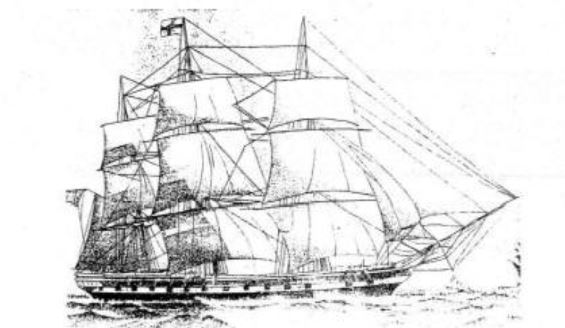
Duchess of Northumberland
Built 1834, 541 tons

I was able to find John arriving in the Colony of Port Phillip on 3 Jun 1841, as a bounty immigrant, aboard the Duchess of Northumberland , after a 107 day voyage from London via Plymouth. The Ship made history, as it carried the first mail and news from England to arrive direct to Port Phillip. Bounty Immigrants had their passage paid for them and a bounty was paid to the agent who had bought them out, but only after the immigrant had been interviewed by the Immigration Board on arrival, and deemed a suitable immigrant. A bounty, in John's case 19 pound, was paid to the agent, John Marshall. On the passenger list for the Duchess of Northumberland, John Myers(Mayers) was described as a 21 year old, Catholic, agricultural labourer from County Clare, who could both read and write. Of the 80 single males on board, 18 were from County Clare and only one of these was not a labourer, he was a carpenter. Four of the men were also accompanied by sisters. Although the steerage on the Duchess of Northumberland was described as lofty and roomy, with more than the 6 foot headroom required, it still lacked ventilation and became very stuffy on hot nights, with passengers often resorting to sleeping on deck. What tempted John to leave Clare and make this long perilous journey? 


Limerick Chronicle, 25 Jan 1840


Advertisements, like the one above from the Limerick Chronicle, 25 Jan 1840, appeared regularly in the newspapers and painted a glowing picture of Australia, at a time when the lower classes in County Clare were suffering. John was born about 1820. I have been unable to find a baptism, but, several siblings were baptised at St. Munchin's, Limerick City, a parish that straddled the Clare/Limerick border. He grew up in a time when land, food and employment were scarce for the landless labourers of Clare. In the fifty years prior to the Great Famine (1845-9), the population had doubled. The demand for Irish food had declined with the end of the Napoleonic War in 1815, so landlords began grazing cattle rather than growing crops, but continued to rent out land at the same high level the war had allowed. Landlords owned half the land in Clare, so with less cultivation, fewer labourers were needed, work became scarce and less demand for crops caused prices to fall and high rents couldn't be paid.  Potatoes, the staple food, were an unreliable crop, with partial failures in several years in the 1820's, that added to labourers' demise. This led to many violent uprisings against the landlords in the 1830's, the future looked bleak. Against this background is it any wonder that John thought he had a better future in Australia.


Melbourne c. 1840 from Surveyor-General's Yard by Robert Hoddle
State Library Victoria's Picture Collection


John arrived in Melbourne in 1841, only six years after it had been founded, the picture above gives an idea of what it was like then. I have found four mentions of a John Myers in early newspapers, but as another John Myers and family arrived in Melbourne in 1849, it is impossible to know who they refer to. However, they do give some insight into the colony at the time. A John Myers was fined on two occasions in 1849, firstly for cutting wood on crown land that wasn't included in his licence and the other for allowing five cattle to stray in the public thoroughfares of the city. The Sands & MacDougall Directory for 1860 lists a John Myers at 22 Little Lonsdale St West. There is a family story that a member of the family ran a hardware type business from a "tin shed" somewhere near where the Windsor Hotel is today. Could this have been it?

According to John's death certificate, he married in Melbourne to a Catherine Lahey(?) in 1857, but I have been unable to confirm this and there were no children. When he died in 1884, he left a will with his brother, Thomas, the sole beneficiary and executor. Thomas inherited 3 lots of land, the most substantial, 38 acres at Lakes Entrance, where John had resided until he came to Shepparton prior to his death. Perhaps the inheritance of this land at Lakes Entrance is the basis of another family story,  that Thomas wanted to move there, but his wife, Catherine considered it far to remote to do so and they remained in Shepparton. Despite John being quite specific about his land ownership at Lakes Entrance, Burn Brook and Wyndham and that the titles were with his solicitor in Melbourne, Thomas swore an affidavit for probate that only the title for the land at Lakes Entrance could be located, details of which were given in the Inventory for Probate and can be seen below. (Blocks 30A, 30D & 30E)


Department of Lands & Survey 1959, Parish of Colquhoun, County of Tambo
State Library Victoria


By coming to Port Phillip, John achieved land ownership, an impossibility for him in County Clare. He lived on a block of land at Lakes Entrance, perhaps drawn there by memories of home close to Limerick City, where the Shannon River meets the seawater of the Shannon Estuary. Finally a connection to a pioneer of Port Phillip.