Tuesday, 30 January 2024

Flookburgh - A Connection to the Past

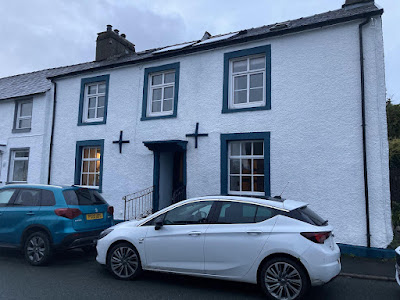
28 Main St, Flookburgh

If only walls could talk, was my first thought as I sat in my room in awe of the floorboards held in place with wooden pegs, not nails, the stone windowsills probably close to half a metre thick and the old dark beams holding the ceiling. I was staying in a very old house built in 1673 on the main road of a village called Flookburgh in the Lake District on the northwest coast of England. The reason for my trip was to get a feel for and learn more about the area where my Townson ancestors had come from.


Floorboards in the house

Flookburgh is unlike the higgledy-piggledy villages in the surrounding areas as its houses were built along the main road. It was historically the main cockling village on the peninsula. Collecting cockles and mussels and fishing in the sands and shallow tidal waters was a long tradition of the area. Collecting shellfish is now done by specially adapted tractors. It is often stated that Flookburgh derived its name from a local flat fish, known as the Fluke, many local people say that Flookburgh wasn't named after the Fluke but the Fluke was named after the village.


Main Street, Flookburgh

It had been a market town of some importance, largely due to it being on the major cross-bay route which connected Lancaster to Furness. Having been granted a charter by Edward I, later confirmed by Henry IV and again by Charles II in 1665, Flookburgh held a market and two annual fairs.

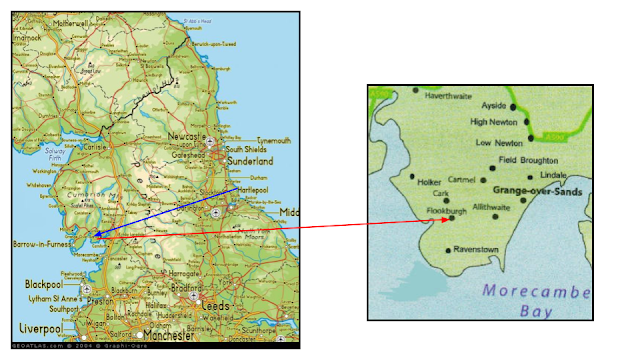
Map showing drive across the north of England and Flookburgh's location

As a prosperous fishing village,  until the end of the 17th century, it had many inns and shops. A couple of disasters possibly led to its demise. In 1669 The Plague was raging in the northwest and the deaths were so great in Flookburgh and caused such terror that bodies were buried in two excavations in a meadow to the west of the village rather than taken to Cartmel Priory, two miles away which was the normal practice. 

On 16 May 1686, a fire destroyed a considerable part of the village, probably near the centre with 22 houses and many other buildings destroyed. Despite this, today nine buildings on Main Street are heritage listed and many more in the surrounding area.

It gave me goosebumps staying in such an old house, which would've existed when my Townson ancestors lived in the village, and being on the main road, they most likely walked past it many a time. It's an amazing connection! In the middle of winter, a few days after Christmas 1716, Elizabeth Townson was baptized in the nearby Cartmel Priory. Her parents, John Townson and Elizabeth Askew were my 6 x great-grandparents and were said to reside in Flookburgh. Elizabeth's brother, John and his wife Alice Greenwood, my 5 x great-grandparents were living in Flookburgh when their first son, John was also baptized in Cartmel Priory at the end of Spring 1740.

Baptism records showed that both families moved around the surrounding area and thanks to my host's knowledge and directions, I could walk to many of these little villages and get a feel for how close together they were. She also lent me a book to read on the history of the area which had been written in 1955 from which I learnt more knowledge of the area. This also led to more explorations over the next two days.

#Flookburgh #Townson #Tounson #Tonson


Saturday, 22 January 2022

A Needle in a Haystack

Sometimes trying to find an ancestor is like looking for "a needle in a haystack" which is how I feel researching my Slevin ancestors. Mary Slevin married Patrick George Rodgers at the Gosport Roman Catholic Chapel in May 1834. Patrick was a soldier, stationed at Haslar Barracks. Their first child, Edward, my great, great grandfather was born at the Barracks in April the following year. Being before compulsory registration and with little information on Church records, I had no idea where Mary was from. According to army records, Patrick was born in Antrim, so I thought it was likely Mary was Irish too, but being unable to find any other records of Mary and Patrick after the baptism of their son Edward, tracing the Slevin's got put in the too hard basket until recently. I needed to narrow down the area in the haystack I was looking, so I started with the surname itself.

Slevin was a surname I was unfamiliar with, so was it an Irish name? Research showed it was indeed the anglicized version of the ancient Irish name "O'Sleibhin", descendant of the son of "Sliebh". The original name holder was an associate of Malachy, High King of Ireland in his battles with Brian Boru. "Sliebh" is Gaelic for mountain and denotes a warrior of magnificent stature. Mary Slevin, therefore, was of Irish descent, but the question now was where in Ireland. Could I narrow it down to a County at least? By looking at the distribution map of the Slevin surname (below) from the Griffith's Valuation, the highest concentrations of the name were in Tyrone, Donegal and Fermanagh, as indicated within the red circle.

Slevin Households in mid 19th century Ireland
(from johngrenham.com)

The next step was to explore my DNA matches to see if I could link to Slevin descendants. Because I am seeking matches to descendants of Slevin ancestors, who would date back to the late 1700's or early 1800's, the matches will be small if at all, another challenge. This is really my only hope, for that early in Ireland, very few records still exist. What I also learnt researching this surname is that there are many variations of it's spelling - Sleaven, Slavin, Slavan and others. Lack of literacy and interpreting dialects added to these variations and another challenge for me.

After trawling through matches on Ancestry, My Heritage and FTDNA using all possible spelling variations I could think of, I had 16 matches varying from 8cMs to 26cMs. Most had limited trees which I built out. What did I learn from this exercise?

Firstly, 5 of my matches descended from 3 children of a pioneer couple of Highland County, Virginia, USA, John Slaven & Elizabeth Stuart. John was born in County Tyrone about 1723 and married in 1740 in Virginia to Elizabeth Stuart, who was from Scotland. I need to be slightly wary with these matches as I also have Stuart/Stewart's in my ancestry, which could muddy these matches. However I do have two more matches that trace back to Tyrone, one to Daniel Slevin & Catherine Holland who married in Tyrone in 1844 and to Bridget Slaven & Bernard McCarville, Bridget having been born in Tyrone about 1818. Bridget's descendants ended up in Iowa, USA, whilst Daniel's came to Victoria, Australia. Of the remaining 9 matches all trace back to Ireland, 2 to Donegal, 1 to Fermanagh, 1 to Belfast, 1 to Roscommon, 1 to Monaghan and 3 just Ireland.

Secondly, I learnt very few remained in Ireland, the majority left, 8 to the USA, 3 to Scotland, 1 to England, 1 to Australia and only three remained in Ireland in Donegal.

Through this exercise I did narrow down the area of the "haystack" to search for my Mary Slevin and it very much coincided with the red circle on John Grenham's map above. In fact I have an inkling that it probably is more specifically Dromore in Diocese of Clogher, County Tyrone, as there were a lot of Slevin's in that area and a few of my matches link back to that area or close to it. Therefore Mary or at least her ancestors were more than likely from County Tyrone. This research has provided as much knowledge about Mary as I'm likely to know due to limited records, but it is a lot more than I knew at the start. It is also another story about the Irish Diaspora.

#Slevin

Sunday, 14 November 2021

My Rodgers Ancestors

Sometimes there are ancestral lines in your family that you can find very little about. From the time my grandmother told me, as a teenager, nearly fifty years ago, that her mother's name was Henrietta Rodgers, I have wanted to know more about this family. Despite my best efforts over the years and having my DNA done all I could come up with was Henrietta's father's name and his possible parents. After a concentrated effort in the last couple of months, I haven't been able to add anymore names, but I have at least been able to add more "meat to the bones" and confirm the names I had.

Edward John Rodgers was Henrietta's father and he had married her mother, Ellen, about six months after her first husband had died, suddenly, leaving her with five young children to bring up alone. Henrietta was born twelve months later in Jan 1877 in Nairne, South Australia. A marriage of necessity perhaps, but Edward turns out to be a poor choice of husband. Within two months of the marriage, whilst he was running a lodging house in Hindley St, Adelaide, an altercation occurred with one of the lodgers, Mary Ann Nutt, who was charged with unlawfully and maliciously wounding Edward after he rather too forcefully chastised her screaming child. She had attempted to empty a basin over his head and in the process hit him in the eye, resulting in him losing the sight in that eye. Evidence was given that Ellen had told him he should not have chastised the child and that he had pushed her away as well. Mary Ann Nutt was found not guilty.

The further back on a family tree you research, the harder it becomes to find some ancestors, and even rarer to know what they looked like. However sometimes you can be lucky and find a description. This happened when, unfortunately, a warrant was issued for Edward's arrest, six months after Henrietta's birth, for deserting his wife, Ellen and his description appeared in the South Australian Police Gazette, Aug 1877:-

Edward was arrested five months later in Jan 1878 at Caltowie, South Australia. It is unlikely that he ever provided for or saw much of Henrietta, as by May the following year he was admitted to Adelaide Hospital where he remained for 163 days before he died on 29 Oct 1879. He died of exhaustion and suppuration of the knee joint and was only 43 years old. The details on his death certificate were provided by George Witcombe, a cabinetmaker who knew nothing of his marital status, place of birth or time in South Australia as these are all blank. When Ellen died she was buried with her first husband's surname. Hospital admission records, however, show Edward was born in Hampshire and had only been in South Australia for 5 years. The ship he supposedly came on the Earl Craig has proved to be elusive and no record has been found of his arrival. Equally his first wife which he alluded to on his marriage to Ellen, saying  he was a widower, has also yet to be found, but I have had more success with his named father, Patrick George Rodgers.


The baptism of Edward John Rogers (above) in Alverstoke, Hampshire in Apr 1835 show his parents as Patrick and Mary and that his father was a soldier. Patrick Rodgers and Mary Slevin had married in the Gosport Roman Catholic Chapel on 23 May 1834.

Lewis's Topograhical Index 1837

From Regiment Discharge Papers and Chelsea Pensioner Records for Patrick Rodgers, I have been able to learn more about him. He was born in the Parish of Blaris, County Antrim in 1815. Blaris Parish is also referred to as Lisburn Parish as it encompasses the town of Lisburn. Lisburn is on the River Lagan which divides the Counties of Down and Antrim and is only 6 miles(9.6Kms) from Belfast. The parish includes parts of both counties. Patrick enlisted in 86th Regiment of Foot under the leadership of Lieut. General Sir Arthur Brooke KCB at Belfast on 3 Jan 1833 as Private No. 814. Records at the National Army Museum show the regiment in 1827 had its first posting to the West Indies and other British possessions, a posting which lasted ten years. The regiment were also at Haslar Barracks in Hampshire in 1834/35, according to a Conservation Area Appraisal in 2018, at the time when Patrick married and Edward was baptised.

Model of Officer of 86th Regiment
c.1858

The 86th Regiment had the nickname, The Irish Giants. Legend has it, when they first began recruiting for the regiment in Ireland, many of its earliest recruits were very tall. This made me wonder was Patrick tall for an Irishman? On his discharge papers, I found a description (below) that showed he was 5ft 6ins(168cms) tall. Was this tall at the time? The Irish Times (13 Nov 2021) reported the average Irish male born in 1980 is 5ft 9ins(175cms) tall, 3 and half inches(9cms) taller than a hundred years ago. On that premise, considering Patrick's birth was 65 years earlier again, he was probably tall for the time, but definitely not a giant! Both he and his son had dark hair.


Patrick was discharged from the regiment on 22 Aug 1837 after 4years and 232 days of service. A board had granted him a discharge and pension of 6/- per day for 3 months due to him being medically unfit for duty. The surgeon's report said Patrick had an enlarged testicle and obscure thoracic disease. He most likely had trouble breathing when he exerted himself, with the cause unexplained. His conduct report stated he was "a good soldier, much in hospital". What happened to the family after his discharge is unknown.

Sometimes you can find lots of details about an ancestor's life, but have no idea what they look like, but in this instance it has been the reverse, with descriptions of both Edward and his father. It made me wonder if the the mop of brown hair, hazel eyes and olive complexion my youngest brother was born with was inherited from Patrick!


#Blaris
#Rodgers


Monday, 3 May 2021

Numurkah Pubs


Above you can see a few advertisements from The Numurkah Leader in the 1890's. Today we think of Pubs as drinking and entertainment establishments, but they were so much more in the early development of towns in Australia. They were a place for communtiy activities when few other buildings existed.
Peter McCaskill (1840-1882)
from Numurkah by W. H. Bossence

The first Pub in Numurkah was run by Peter McCaskell. He and his wife, Catherine, were the first people to take up residence in the town and even named their daughter Florence Numurkah McCaskill to honour the fact. Peter McCaskill dispensed beer and lemonade from the back of his cart on his arrival in the town in 1877. The cart quickly progressed to a bark hut, the first building in the town, then work began on a more permanent weatherboard structure, which opened as the first Numurkah Hotel on the corner of Melville and Quinn Street (the site of the State Savings Bank in the picture below, next to the now Numurkah Hotel). In November 1877, a grateful traveler reported sleeping in the partly built Hotel that existed of a roof and walls, but, no windows or doors. He was protected from the rain that fell that night and slept well using his saddle as a pillow and a rug to cover himself. Peter McCaskill had put this traveler's horse in a paddock and provided the weary traveler with tea and breakfast. The early buildings of Numurkah were wooden structures and fires were a constant problem and many burnt down including several of the earliest hotels. 

Numurkah Hotel, built 1910, Rose Stereograh Co (1920)
(State Library of Victoria)

Although the town of Numurkah was proclaimed on 8 Feb 1875, the first land sales didn't occur until January 1878 and even then Peter McCaskill's block wasn't offered for sale, he had to wait until the middle of 1878 to buy the block his Hotel stood on. He also bought the adjacent block and two other corner blocks on Quinn Street. The Numurkah Hotel opened on a hot day in early 1878, to coincide with a race meeting that took place. It supplied refreshments to all despite the lack of a licence and a ball finished off the day. As the first permanent building in the town, it served many purposes. It was a post office, a place to hold socials and magic lantern shows, the site of the first Protestant service, as well as the first public meeting, and the first sale, whch was held in the yards of the Hotel. It was the centre of early community life in Numurkah. In 1881 an agency of the Commercial Bank of Australia opened in the dining room of McCaskill's Numurkah Hotel. By the end of 1881, there were four other Hotels in Numurkah, the Farmers'Arms, the Commercial, the Royal Mail and the Globe. Both the Farmers' Arms and the Globe were burnt down.

The Globe Hotel 1888 before it was burnt down.
from Numurkah by W. H. Bossence

The extension of the railway line from Shepparton to Numurkah opened in 1881 and with it the people came too. Numurkah boomed as the service centre for the area. Unfortunately Peter McCaskill didn't live to enjoy the benefits of this boom, dying, aged 42, on 23 Jan 1882 only five months after the railway had opened. From 1881 to 1891 the population grew from 96 to 1011. When farmers brought wheat to town, they required a stopover of 2 days. More hotels opened. As part of their licence, hotels were required to have a light at the main entrance, if the street was unlit, have feed available in their stables, provide meals if asked for, ensure the safety of their patrons and if the hotel was more than 2 miles from a police station or morgue, receive a body for the purpose of an inquest if requested. The Telegraph Hotel, built in 1882, was the first two storey building and is the oldest surviving Hotel in Numurkah. It was built of red brick, in a Victorian Classical style, and represented the booming Hotel trade at that time.

Telegraph Hotel - The oldest, surviving Hotel in Numurkah

Another Hotel originating back to 1882 was the Railway Gate Hotel built on the south-east corner of McDonald and Knox Streets owned by a Mr Thomas McTighe, who was also an original selector of land in the area like my great, great grandfather, Jeremiah McAuliffe and a close neighbour of his.

The Farmers Arms was the second hotel in Numurkah, originally a wooden structure that burnt down in July 1890.  The building that replaced it unfortunately was demolished before it's heritage value was realized. For those interested in VFL history, an early 1900's licencee of this hotel was the father of Dave McNamara, well known local and St.Kilda footballer, who was noted for his long kicking, one kick in particular of 84 yards, a place kick!

The Farmers'Arms - now demolished

In 1901, Numurkah had a population of 1,125 and 10 hotels operated, showing the importance of these venues for the community.

#OnePlacePubs

References: Numurkah by W. H Bossence, The Numurkah Leader newspaper.


Wednesday, 17 March 2021

Mary Anne McAuliffe ( 1867 - 1905 )

                Woman                

Let woman keep her sphere; Why should she strive

With man for mastery in the rough life,

Formed not as he, but subtler in strength

To move to mightier ends in homely ways.

  The Numurkah Leader, Sat 4 May 1895, Pg 3.

In 1891 a petition had been presented to the Victorian Parliament with nearly 30,000 signatures and addresses, demanding the right for woman to vote in the colony of Victoria. Of the 64 woman of Numurkah who signed this petition, there is not one I can link to my family. It was a time when many woman were finding their voice, but the newspapers were still publishing articles like the poem above and this below entitled The New Woman

Our Melbourne correspondent thus writes on the above subject:- I am not personally an advocate of woman's suffrage and I give my reasons: the best and most womanly woman do not ask it, and if it were given to them, would not exercise it; and those who demand it would not ( for the most part) improve the tone of the Community or the character of legislation by votes.... The Numurkah Leader, 19 Sep 1895

Against this backdrop, Mary Anne McAuliffe married James Sullivan in Numurkah on 25 May 1894. She was a month off her 27th birthday when she married James, eight years her senior. Mary Anne was my great, great Aunt, the second of eight children, the first of her family, to be born on Australian soil at a place called Ballard's Camp near Toowoomba, Queensland. Her Catholic, Irish, immigrant parents, Jeremiah McAuliffe and Kate Ford, both from County Cork, had married in Southwark, Surrey in 1864, only a month before they boarded the ship Elizabeth Ann Bright that brought them to Moreton Bay, Queensland. Mary Anne's elder sister, Johanna was born at sea during the voyage. A nod to the family's Irish heritage can be seen in the naming of the girls, Johanna after her paternal grandmother and Mary Anne after her maternal grandmother. 


Railway Tunnel near Ballard's Camp 1894
Queensland University of Technology


Being born at Ballard's Camp was an indication of what Mary Anne's early childhood was like, her father constantly moved around the country to find work and took his young family with him. Ballard's Camp had been established on a rounded knoll on a ridge as a construction camp for the building of a difficult section of the railway at 2300ft above sea level. The one consolation to the family living there, unlike Ireland, the climate was the mild with not even a frost. 

By the age of three, Mary Anne and her family were living at Glengallan Swamp near Warwick, still in Queensland where her brother, Cornelius was born in 1870. Glengallon Swamp was the site of another railway camp at that time. However by 1872 the family had ventured further afield to Avenel in Victoria where her sister Margaret was born. A report in The Age newspaper, four days after Margaret was born, stated if favourable weather continued the tracks of the North-Eastern railway would reach Avenel in a fortnight, suggesting her father still had something to do with the railways. By 1874, the family were in New South Wales where my great grandfather, John, was born near Forbes and duly named after his maternal grandfather. Mary Anne now seven and a half had spent much of her young life moving about the country. This came to end in February 1878 when her father was granted over 300 acres of land at Katunga on the outskirts of Numurkah.

Mary Anne and her siblings were finally settled. When Numurkah State School officially opened for the first time on 4 March 1879, Mary Anne and her two siblings, Johanna and Cornelius, were on the enrolment list. Mary Anne was about to turn 12 in the April. Whether they actually attended was a contentious point, as the route to school was some distance, heavily wooded and difficult to navigate, their names may have been used just to make up the numbers to open a school.

By the age of fourteen, Mary Anne and her family were well settled on their farm in a log and iron house, 30 x 14 feet with a fenced and planted garden and 112 foot well for water. Eighty three acres had been cleared and planted to wheat and oats. The property also had a bark hut, bark stable and a bark and log Dairy. Life was comfortable for the family.

Jeremiah McAuliffe, sadly, didn't live to see his daughter marry, having died of influenza four years before the wedding. Not quite six weeks after the wedding, Mary Anne gave birth to her first child, Michael McAuliffe. He was born at 39 Henry St, Hawthorn according to the birth certificate filled out by her mother, Kate, and named the father as 30 yr old, Jeremiah McAuliffe of Shepparton, with the marriage date of Mary Anne and James Sullivan. For whatever reason, Mary Anne did not keep her first son, but gave him to her Aunt Margaret, her mother's sister to raise. Margaret Ford was nearing 60 years of age and had never married. There was a Jeremiah McAuliffe of the same age, who lived in Shepparton at the time, but was he really the father or a convenient way to give Michael the McAuliffe surname. Michael was known in Numurkah as Mick Ford, which came to light in an article written in the local paper, when he was given a rousing reception on his return from WWI. A little over twelve months after Michael was born, Mary Anne, gave birth to her second child, another son, who she also called Michael!

As with most women of this time period their are no records of her life except when she had or buried her children. Mary Anne had ten children in her eleven and half years of marriage, only six lived to adulthood. Michael McAuliffe, her eldest child, never married and spent his final years with John Sullivan, who certified his death, as his brother, and that Michael's parents were James Sullivan and Mary Anne McAuliffe. Mary Anne gave birth to twins in Nov 1905, only one of whom survived. At the time she was suffering influenza that developed into pneumonia. She passed away eight days after the birth as described in this newspaper article.


The Numurkah Leader, 10 Nov 1905


Sadly, Mrs J Sullivan suffered the same fate as her father and brother, dying of influenza. A sign of the times and illustrating the difficulty of researching woman ancestors, she was not mentioned by her own name but in terms of being the wife of James Sullivan. Mary Anne Sullivan (nee McAuliffe) was buried in an unmarked grave at Numurkah Cemetery at only 38 years old. In roughly a two and half year period between 1900 and 1902, Mary Anne had given birth and buried three children, Kate, John and Margaret and her last baby, Thaddeus was buried only six days prior to her own death. Gone, but not forgotten. 

Mary Sullivan (nee McAuliffe 1867-1905)
Thaddeus Sullivan (1905-1905)
Margaret Sullivan (1902 -1902)
John Sullivan (1901-1902)
James Sullivan (1860 - 1932)
Numukah Cemetery
Graves 483 & 484

#OnePlaceWomen


Sunday, 14 February 2021

Numurkah Railway Tragedy


Numurkah Railway Station c.1908
State Library of Victoria

Numurkah Railway Station opened in 1881 as the terminus of the railway line from Shepparton. The town expanded as the farmers of North-East Victoria brought their wheat harvests into town to be transported. The railway line was further extended in 1888 to Strathmerton, Cobram and Nathalia and then further to Picola in 1896. With the development of the railways, there came the inevitable accidents. Local papers reported many mishaps. A nine year old girl survived a fall from a moving train after she lent on a door with a faulty catch, a train ran into a laden coal wagon, when a switch hadn't been changed back to the main line, a train ploughed through gates narrowly missing the lady trying to open them and a drunk fell from the platform, smashed both ankles and survived being run over by a wagon. Another drunk wasn't so lucky.


Railway Lines c.1930


By far the saddest report, which was picked up by newspapers around the country, was the tragedy that occurred on 5 October 1905. On this hazy Thursday evening, with only a half moon for light, a buggy carrying six people was hit by a train at Allan's Crossing, about two and a half miles from Numurkah, resulting in the death of three people. The buggy, pulled by two horses, was being driven by Mr. George Russell, with him were his two daughters Edith, 20 and Winnie 16, Annie and Lily Callender and Orlando Purton, 14. Mr. Russell, Winnie and Orlando died whilst being taken by the train for treatment after the accident, Annie and Lily suffered serious injuries and Edith survived unscathed. The bodies of the deceased remained in the waiting room of the Numurkah Station until released by the Coroner on the Friday evening, despite a request by police for an earlier release to their families. 

The town of Numurkah mourned. Mr. Russell was from a local firm of Auctioneers & Commissioner Agents. His partner, Mr. Reynoldson was the representative for Deniliquin in the State Assembly. Annie Callender was the daughter of Numurkah Butcher, Robert Callender and Lily was the daughter of Samuel Callender, also of Numurkah. George Russell had lived in Numurkah for 27 years and was well known not just for his work, but his invovlement on several boards and his charitable endeavours. A large funeral for George and Winnie Russell was held 7 October 1905 and Orlando Purton's on the following day. Orlando's parents were not well off and generous donations paid for the the funeral and more.


Funeral of George & Winnie Russell
The Numurkah Leader, Fri 13 Oct 1905

An Inquest was held, before the funeral, on the Saturday morning, 7 October by the Coroner, Mr. Read Murphy, P. M. where Edith Russell, the surviving daughter, the engine driver, William Welsh and the Fire Guard all gave evidence. There were representatives for the Russell family, the Railway Department and the Crown. As the evidence unfolded, it appeared this was an accident that could easily have been avoided. Edith stated they were all aware of the train as they travelled in the same direction along the road parallel to the railway line, although she was unsure whether the train whistle had blown. They were returning from a day at the Nathalia Show. As they drew closer to the crossing which was at an angle to the road, her father whipped the horses as he believed he could beat the train, which they had also thought and it wasn't until the last minute when they turned to cross the track that they realized the danger and yelled to stop. It was too late, the train hit them. Edith said she was seated between her father and Orlando and remembered a big bump and coming to on the ground. She also added her father was a good driver and perfectly sober. The engine driver and the guard both said the whistle had been sounded, the lights were in good order and they were travelling at a rate of 30 miles per hour.

"Mr. Read Murphy said it was perfectly clear that Mr. Russell had seen the train a long distance off. The whistle was sounded and the lights in good order. No blame was attachable to anyone. Mr. Russell had formed an inaccurate idea of the distance. He (Mr. Murphy) did not intend to make any comment. Nothing had any effect on the public who regarded too highly the danger connected with these crossings. He found the deceased came by their death by being run over by a train at Allan's Crossing." The Argus (Melbourne) 9 October 1905.

It was considered an accident, but one can't help but wonder whether the same verdict would be given today.

 A chilling postscript to this story appeared in the Euroa Advertiser, 20 October 1905. Winnie Russell had recounted a bad dream to her mother on the morning of the accident. "Oh mother, I have had such a terrible dream. I dreamt that father and I were killed." When her mother asked how, her reply was " I don't like to tell you, it is too terrible." Another daughter, Elsie, away at school in Melbourne, had made an unexpected visit home on 28 September, the week before the accident, because she too had had a bad dream. In her dream she had been summoned home because Winnie and her father had been killed, which is exactly what happened a week later! 

#OnePlaceTragedies


Friday, 29 January 2021

Brick Water Tower - A Landmark of Numurkah


Brick Water Tower, Numurkah c.1890
unknown photographer, State Library Victoria


This year I have decided to follow the monthly blogging prompts of the Society of One Place Studies. Prompts will be a different topic each month. My One Place Study is Numurkah, a town in north eastern Victoria. It was declared a town in 1875, and the first land sales occurred in 1878, the same year my Irish great, great grandfather, Jeremiah McAuliffe selected land and settled with his family at Katunga on Numurkah's outskirts. The prompt for January is Landmarks and I have chosen the Brick Water Tower.

The Brick Water Tower was built in 1888 on the west bank of the Broken Creek. Initially Numurkah's water supply had come from a lagoon in the Creek (sometimes referred to as Baala Creek, the aboriginal name) and a well on the south-west corner of Gray and Quinn Streets outside the Bible Christian parsonage. The lagoon was often dry and, with the population growing from 96 in 1881 to 1011 in 1891, a more reliable water supply was needed. Tenders were called for in October 1888 for a water tank, tower, engine house and settling tanks. The 70 foot tower was constructed using 70,000 bricks and was finished with an iron tank on top.

The height of the water tower also made it a useful vantage point to take photographs for postcards of the growing town as can be seen below:-


Numurkah from Water Tower, c.1907
Shirley Jones collection of Victorian postcards
State Library Victoria


Broken Creek in Flood from Water Tower, c.1908
Shirley Jones collection of Victorian postcards
State Library of Victoria

Moira Shire, Stage Two Heritage Study 2007, identified the Water Tower, a footbridge and the showgrounds as culturally significant places built between 1880 & 1900 in what they classified as the Recreational Precinct of Numurkah. They noted the Water Tower demonstrated original and early design qualities associated with water infrastructure development of Numurkah. The Study also stated:- 

"The materials and workmanship seen in the significant timber bridge and brick and iron water tower infrastructure are technically important and increasingly rare examples in Numurkah."

This Recreation precinct now has a Heritage Overlay and it is Shire policy to retain the significant buildings in the precinct, so the Brick Water Tower should be a landmark for many years to come.


The Footbridge over the Broken Creek
 with Brick Water Tower 

#OnePlaceLandmarks


Tuesday, 7 July 2020

Book Prizes - What can they tell us?


Books awarded as prizes to Norah & Eileen Myers

The above books have sat on my bookcase for over thirty-five years and although I have looked at and handled them numerous times, I had never actually read them until recently. The one on the left was awarded to my great, great Aunt Honorah Myers, known as Norah, as a twelve year old. It was first prize for Poetry when in 2nd Class at St Mary's Convent, Rutherglen, Xmas 1906. The other book was awarded to her younger sister, Eileen, as a nine year old. It was 1st prize for English when in fourth grade at St. Mary's School, Rutherglen, Xmas, 1911. The two girls were the youngest of a family of 10 children of John Myers and Margaret McAuliffe. All four grandparents were Irish Catholics who had come to Victoria in the 1850's. Sadly both girls died in their twenties and neither married, although Norah had a son Cecil supposedly fathered by a famous tennis player. Another married sister also died in her twenties. On reading the books I was very surprised at the stories they told, which prompted me to research more about the books and their authors to try to understand why they were chosen as prizes.


Inscriptions in each book

Many of us have items passed down to us and it can be a valuable exercise to record what you know of these items and who they belonged to, so their history is not lost to future generations. If you also do some research on these items, it can add extra context to the original owner's story. Having finally read these books, I wanted to know more about them. They were both supplied by William P Linehan, 309 Little Collins Street, Melbourne. William Lineham's obituary in The Advocate, Dec 1945, described him as "Founder and Principal of Well-known Catholic Bookshop". He had set up his own bookshop in 1895 and had a hand in setting up two well known Catholic publications, the Austral Light and the Tribune, the latter being published for several years on his premises. Requiem Mass was held at St Patrick's Cathedral with the Archbishop presiding. Books from this supplier would, therefore, have been considered suitable prizes to their students by the Nuns, who had only recently come from Melbourne to Rutherglen. St Mary's School and Convent had only been established in March 1901 after a request by the Parish Priest, Fr. Micheal O'Connor, to the Presentation Nuns in Melbourne to sends some Nuns to educate the children of the Parish. Did the Nuns actually know what the stories were about or am I surprised at their content because I am viewing them with a 21st century perspective?

The Adventures of a Casket, An Episode of the Invasion of 1814, by Theophile Menard, translated from French is of superior quality and was awarded to Norah Myers. The flowery section of the cover is textured, while the grey section is embossed in silver and wraps around to a similar depth on the back. The spine has only one word on it "Casket", a hint to the story. It appears to have been read many times and greatly treasured. It has no publishing date, but a copyright of 1876 by Benziger Brothers. Benziger Brothers were a Catholic book publishing company founded in 1792 in Switzerland by Joseph Charles Benziger and later run and expanded by his sons and grandsons. They were bestowed the title of Printers to the Holy Apostolic See in 1867. The Holy See being the government of the Catholic Church based in the Vatican.

The story is told from the perspective of a young man's experiences of the Austrian invasion of France in 1814, when it was necessary for the French to hide their valuables from the invading Austrians. Set in the village of Baume les Dames, many took advantage of hiding their valuables in a vault under the local chapel. The young man had been given the duty of looking after a lady and her niece, whilst the husband was away on business. The valuables belonging to the niece were placed in a casket, and together with several other cases packed with family valuables, the young man was charged with taking them to the Chapel for safe keeping. There is a great deal of detail about the over running of the village and the battles nearby, as well as the entertaining of officers and billeting of invading troops. The casket, a plain wooden box, never made it to the vault and was inadvertently left in the kitchen area of the Abbey where soldiers stayed, some cleaning their boots on it, but it was never opened. When the army finally left and the valuables of the villagers were reclaimed, there was great dismay that the casket with its valuables was not there. The young man, who was responsible for hiding it was mortified and offered to pay for it when he could. Weeks passed before the casket was found and the moral of the story was "What God guards is well guarded."  Although an interesting historical story it wasn't one I thought appropriate for a Poetry prize for a 12 year old girl.


The Opening Pages of each Book

The Old Gray Rosary, by Mrs Anna H. Dorsey, is in a slightly more tattered condition, possibly because of its lesser quality, with thicker paper and some pages printed on a slant. There is no publisher or publication date, only a small Irish Trade Mark stamped on the last page that I can find nothing about. The spelling of "gray" in the title indicates its American origin. Anna was born in Washington D C in 1816, the daughter of a minister. Both Anna and her husband were converts to Catholicism and she is remembered as a pioneer of Catholic literature in America. She was the author of numerous short stories and novels, the majority of which concentrated on the melodramatic and religious conversion.  In 1889, Anna was awarded the Laetare Medal, by Notre Dame University, Indiana, in recognition of outstanding service to the Catholic Church and society, the most prestigious award given to American Catholics. Another well known recipient of this medal was President John F Kennedy. She lived through a time of great upheaval in America with her only son killed fighting for the Union side in the American Civil War.


The Irish Trade Mark

The story begins with a girl asking questions about her mother's collection of rosary beads among which are the old gray rosary beads, described as ugly and forlorn. They were made of beans and brass wire and belonged to a slave. This led to the girl being given a manuscript written by her grandmother which told the story of those beads described as:

     "a true narrative of the struggles of a poor negro slave, with the infirmities of her nature and the sins of her life; who, disheartened by frequent failure and the evil consequences of the great sin of  her life, abandoned the sacraments of the church and everything connected with her religion, except devotion to the Blessed Mother of Jesus Christ."

It is a story told from a Protestant point of view and wasn't very flattering to Catholics. The girl's grandfather was a slave owner, who treated his slaves better than most, with ill-treated slaves coming to ask him to buy them. He often did, but only bonded them for a certain number of years and then granted them their freedom. Mary, the owner of the beads, was one of these slaves who had been brutally treated by a drunken owner and had herself resorted to drink in the mistaken idea it would drown her sorrows. Mary was now treated well, cooked for the family and looked after the children. Everyday she prayed using those gray rosary beads. The daughter of the family, was curious about both this habit and Mary's religion. She was allowed to accompany Mary to her Church, where she was captivated by the paintings, statues and rituals which were much more interesting than the austere Protestant church her parents went to. Mary had lapses to her old ways and was given many chances. One night looking after the children, she left them alone for a few minutes and an accident with a candle occurred, with one of the younger children dying of burns. The grandfather immediately emancipated his slaves and the family moved North. Mary's Catholic influence was forgotten. The family returned after many years and the daughter married a Catholic and converted. By chance she reconnected with Mary, who had had a sad life, but still clung to her old gray rosary beads and recited the rosary three times daily. Again I found it a strange book to give to a 9 year old, Catholic girl, as the majority of the book is focused on the Protestant religion.

By reading and researching these books I have learnt about the type of books my great, great Aunts were given to read and although they were being educated here in Australia, the books were published overseas about historic stories there. Australia was still finding its identity, as was seen when WW1 broke out a few years later and Australian men enlisted to help Britain, the mother country. An interesting side note to this story is in December 1906 when Norah received her prize, her older brother, Patrick applied for a special licence to marry Mary Louisa Williams, a protestant. Patrick and Mary were my great grandparents. On the same bookshelf as the above books I have three books awarded to Mary Louisa Williams, for Good Conduct, when she attended Sunday School at St Stephen's, Church of England, Rutherglen. 


Wednesday, 24 June 2020

2020 - The First Six Months

Now that we are in the last week of June, I felt it important to record my thoughts on the year so far. Many times when researching my ancestors have I wished that they had done that very thing. There was an ominous start to the year with bushfires raging around the state of Victoria. Living in Warburton, surrounded by beautiful, lush bushland and trees for most of the year, summer is a time to be prepared and alert for fires and this year was no different. We were lucky, despite being blanketed by smoke, we didn't have any local fires, but sadly a vast area of the state wasn't so lucky. Lives were lost, properties burnt and businesses, in areas that usually boomed in the holiday season, suffered. Vast amounts of money was raised for people affected and even Katy Perry gave a free performance, to raise spirits, in Bright, one of the towns that suffered during this time.

With the bushfire disaster still fresh in our minds, another disaster was spreading across the world, the Covid-19 Pandemic, this would and still is changing our way of life as we knew it. It had begun in Wuhan, China and spread rapidly throughout the world. Initially, I don't think any of us realized how bad this virus was, but then the numbers of people dying in other countries and the inability of the hospitals in these countries, especially Italy, to cope scared us all. Cases started appearing here and luckily for all Australians, our government and expert health advisors acted quickly to close our borders to the Chinese and then all international visitors. Australians rushed to return home, with some of these bringing the virus with them. Numbers of cases rose, deaths occurred, quarantine of arrivals in the country became necessary and we were all forced into to lockdown.

The fear of lockdown caused another problem, consumers panic buying, supermarkets were cleared very quickly of basic supplies. The most hard to get item for weeks was toilet paper! Limits were put on many items, like flour, pasta, frozen vegetables and mince for weeks. Despite government reassurance we could leave our houses for essential items, health needs, exercise and to go to work if you unable to work from home, people continued to buy up big causing shortages for people that didn't panic. The lockdown worked and cases of the virus dropped, but with the relaxing of restrictions cases have again begun to rise. People have become complacent.

As with everyone else my normal routine came to a stop. First and foremost I was confined to my own house for an extended time. For nearly ten years, I had been doing lots of housesitting and spending nearly half the year in other peoples' houses. Initially I saw it as a chance to do all the things I had put off, the pantry got cleaned, the kitchen drawers and a cupboard were sorted, but the novelty soon wore off. I did finish hand quilting a quilt I had made for my daughter's twenty-first birthday and gave it to her for her forty-first!

Many other habits changed as well. My regular cappuccino and reading the paper at the local cafe stopped and I had to resort to making a milk coffee at home and reading the paper online. I regularly went to genealogy discussion groups in Melbourne at least six time a month, these abruptly halted with a couple resuming on Zoom. I had never heard of Zoom before this pandemic but now I have attended a book launch, a webinar and meetings via this medium. Stuck at home, I realized I needed to go for a walk just to break the monotony of the four walls, so this has now become part of my regular routine. I feel better for it and have managed to loose a couple of kilos as well. Another change, from staying at home more, has been the increase in my power bill, but at least the petrol consumption in my car has gone down. All this extra time has allowed me to do more genealogy. Most afternoons I now spend on my computer researching or sorting DNA matches, which has more than kept me occupied. I must admit I am very happy that the football has recommenced, as that has always been a constant in my life during winter. Nothing I like better than to settle down with my knitting or crocheting and watch a game of football or two or more! Watching football without crowds wasn't quite the same, but now they have added crowd noises to the broadcast it is much better.

I have always been an avid reader of the newspaper and I watch the news on TV most evenings. I have been continuing to do this, as well as watching government press conferences, to keep up to date with latest information on the pandemic.  Although aware of media bias and shortfalls in the past, it has become more obvious to me during this pandemic how selective and manipulative the media can be. Social media has also had a major influence on issues during this pandemic and not always in a good way. Everyone is entitled to an opinion, but when that opinion is based on selective facts and given a lot of media coverage, it is a recipe for things to get blown out of proportion.

Unfortunately during this pandemic, a lot of emphasis has been placed on the negative aspects of it and the deprivation of freedom, rather than the numerous positive aspects that have occurred as well. Conspiracy theories by a small minority have been spread on social media, such as the government are on a power trip to control us or have an alternative agenda. The devastation and loss of life around the world is a clear example to me, the government's priority is about keeping us safe. Some people will accuse me of looking through rose coloured glasses and I admit it hasn't affected me like others that lost their jobs or had to home school. Being restricted in movement has allowed many people to take stock of their lives, realize what is important to them and spend more time with their immediate family. Home cooking, jigsaws, board games, reading, home maintenance and working from home have increased during this time and many believe a lot of these things will continue long past this isolation time. Some old habits will not return. Online shopping and the use of card rather than cash are seen as lasting changes caused by this pandemic. Hopefully health etiquette and staying home when unwell will be other habits that continue. On the whole I think there has been a greater appreciation and awareness of the work done by our service industries, teachers and health workers during this time.

The things I missed the most during this time were my regular cappuccino and conversing with other people. However the lack of routine allowed me to do a lot more of the things I enjoy, genealogy, jigsaws, crafts and reading whenever I felt like it. The most annoying aspect of this time has been the selfishness and whinging of some people, the lack of adherence by some to the rules set, when the vast majority were doing the right thing, and the attitude of a minority that the government were over- reacting.

In this last week of June, there has been increased anxiety, with virus numbers increasing again in Victoria and a relaxing of restrictions curtailed. Hopefully measures now in place will be enough to stop this second wave before it gets out of hand and serve as a reminder to all that we still need to take precautions and social distance. Hopefully the second half of 2020 will be better than the first.


Monday, 25 May 2020

The Search for the Elusive Slowbohms

My great, great grandfather and his father had the middle name 'Slobourn', but where had this name come from? In 1994 I purchased the marriage certificate of my 3 x great grandparents, Joseph Slobourn Williams and Harriett Barnett who were married in Beechworth in 1860. On this certificate Joseph stated his mother was Ann Slobourn. Joseph, it appeared, had been given this middle name as it was his mother's maiden name, a quite common tradition and he had then carried it on to his son. Joseph signed his full name on his marriage certificate, with his middle name spelt 'Slobourn' and this was one of many spelling variations I have come across.

It is often assumed the less common the surname the easier it will be to trace the family. Even Ancestry advertisements imply all you need to do is type in a name and all will be revealed! This certainly didn't happen in this case. Joseph had also stated that he was born in Wales. A Williams in Wales is going to the other extreme, but at least his father had married a Slobourn, so I thought I might have some hope of finding their marriage. No such luck! Census records drew a blank, I just had too little information with such a common name as Williams. Then one day in 2009 as a last resort I typed Slobourn in Google and up came the name Mabel Sloburn Williams in a family group sheet on the Ballarat Genealogy site. She was a daughter of a Thomas Williams, a carpenter, born in London. It was a reasonable assumption to think that Thomas and Joseph were brothers. I now had that little extra information to try the census records again and finally found the family living in St Pancras in 1841. It also showed Ann and the children had not been born in the county, so perhaps Joseph had been born in Wales.

Another few years passed until I received an email from a second cousin, who after much patience had found the marriage of Ann Slowbohm and Joseph Williams in St Pancras in 1821 on Pallot's Marriage Index. Ann's surname had been written and transcribed as 'Horobohm' despite the index having (?Slowbohm) next to the name. Finally the marriage and the first appearance of this spelling of the name. I then went searching for Slowbohms and found a few living in Whitechapel and although I could not link them to the family I felt there must be a connection. A few years later I did eventually find Ann's baptism in St Pancras in 1824 (three years after her marriage) which gave both her year of birth and her parents names, Ann and John. That is where I had left the research until this week.


 Pallot's Marriage Index Entry

A trip to England in late 2018 made me determined to find as much as I could before I went. Several long afternoons trawling Ancestry, Find My Past and Family Search as well as rereading collected information proved a worthwhile exercise. However it was not before learning that Ancestry gave a few names that matched and then proceeded to throw up the name Sullivan as the next best variation. Very unhelpful! It was a long list, however when using various wildcards, the lists were a manageable number around 2000! What amazed me was the variation on both how the name was spelt and how differently it was transcribed. A few of the variations included: Slowbohn, Slobohm, Slowboahm, Slowbome, Slowbottom. Slowbhom, Slowthbom, Slobin, Slogan, Slobourn, Sloburn, and Horobohm.

Now after all these years through perseverance and the availability of more online records, I have linked most of the Slowbohms in London to my family back to John Henry and Susannah Slowbohm, my 7 x great grandparents, born in 1726 and 1732. John Henry died in 1790 and left a will, which now provides a challenge to try to decipher it. Slowbohm seems the most common spelling of the name in England, but once the brothers came to Australia, the name became more anglicized. It has been a great research journey that hasn't finished yet.

Tuesday, 28 April 2020

DNA, Ethnicity, Matches & More.

Pocahontas
Credit: Three Lions/Getty Images


Much history can be learnt by exploring your DNA results, like the story of Pocahontas! When I first receive my DNA results, like everyone else, I looked at the ethnicity to see if there were any surprises and then onto the thousands of matches I had. DNA can open up a whole new world to explore, learn, verify and add details to your family history story, but it can also be quite overwhelming. You have to work hard to understand and interpret these results meaningfully. I am at the stage now after lots of reading, attending talks, watching YouTube, uploading to other sites and using other tools like Genetic Affairs, Gedmatch & DNA Painter, that I have managed to break several brick walls and work out a lot of matches, but there are a lot more matches that I will probably never work out. That is okay too, as you can learn from these unknown matches too. They can give you an insight to where some of your ancestors lived, where some may have migrated too and other valuable context to your family history story.

I have broken the majority of my matches above 15 cMs at Ancestry into maternal and paternal matches, giving them an appropriate pink or blue dot. Now it starts to get tricky and requires a lot more research. Firstly I have just over a hundred matches that I can't allocate to either maternal or paternal. DNA is only one tool used to help you discover your ancestry and unless you have an extensive tree to start with, you will find it quite difficult to recognize names in other trees and place your match in your own tree. Your matches themselves are never wrong, but their trees or your own may be wrong, so you need to be prepared to uncover surprises. For many reasons you may not have been able to extend certain lines of your family. I am 77% Irish and  Irish records are very limited. With some family members going to America and other coming to Australia and very few remaining in Ireland, DNA may help link these families again. My paternal grandfather was the only member of his family to come to Australia and his line links back firstly, to Ulster Scots, a lot of whom went to America and secondly to Wales, with the common surnames of Jones and Powell, so DNA is an invaluable tool to try to sort this out too. Once you have worked out the easier matches, it is necessary to take the analysis up a notch.

With plenty of time on my hands at the moment, I have decided to make a concerted effort on my paternal line. My paternal grandfather, John William Graham was born in North Yorkshire, his father, James and grandfather, John were both born in Glasgow, Scotland. When the elder John Graham married Mary McMullan in Glasgow in 1862, both sets of parents were deceased. John's parents were John, a hand loom weaver and Elizabeth Graham ( Elizabeth's maiden was given as Graham) and Mary's parents were James, a gamekeeper and Mary Stewart. James and Mary were married in Ballymoney in County Antrim in 1834, suggesting they were Ulster Scots. That is the extent of the information I know about my great grandfather's parents.

The key to sorting DNA matches, is to be systematic, using what you do know to help sort the unknown. Clustering tools are an invaluable step, whether it is the Leeds method, Genetic Affairs, My Heritage or just using pink, blue and other dots at Ancestry. By knowing where one person in a cluster fits into your family this enables you to to know where others in this cluster must fit, although  a little more research may be necessary to work out where exactly. By only using my paternal matches from Ancestry on Genetic Affairs I was able to work out the clusters related to three out of four of my paternal lines, my paternal grandfather's father and mother and my paternal grandmother's mother, but nothing related to my grandmother's father.

My paternal grandmother, Annie Edith Walmsley, was born in Adelaide and I was hoping DNA would verify the work I had done on researching her ancestry. It did on her maternal line with numerous matches, however, her father, William Walmsley from Lancashire, for whom I have an extensive tree, nothing and for her mother's father Edward John Rodgers, born to Northern
Ireland parents in Hampshire, nothing. It is possible that no one on these lines have survived or taken DNA test, but it is possible that the paternity in each case is different to what was put on the certificates. Are the 117 matches that don't match either side of the family the answer to this conundrum? Something I will have to look at more deeply.

At the moment I have started building trees for the matches in the largest cluster, which I believe are related to my paternal great grandfather and that line, I know least about. This cluster has 48 matches (16.1 - 35.5 cM). About 20 of these have no trees, 8 have large trees and the rest have trees that need expanding to be of any use. I have expanded 6 of these trees further, but as yet have been unable to find the connection. However I have learnt a lot from this exercise about my ancestors who ever they were! All the ancestors of my matches in this cluster are concentrated to three areas of early settlement in Canada and America, namely Nova Scotia, Virginia and North Carolina. While expanding trees I learnt about the isolation in the early days of these settlements, slavery, the pride of being a descendant of a revolutionary soldier and the intermarrying within these small early communities, which may skew some of the DNA results. I read wills, family stories and histories of small communities. Many of these early settlers came from Northern Ireland and Scotland where my great grandfather's ancestors came from.

Emblem for Sons of the Revolution Organization.

One of my matches is a coloured lady and on expanding her tree I found that several of her ancestors were classed by the now derogatory term "Mulatto" of mixed race. One match tells of a story handed down, that an ancestor had changed his name in order to marry a coloured woman, as mixed marriages were frowned upon, whilst in another, a family line could be traced back to Pocahontas, an Indian woman, the daughter of an Indian chieftain, in the very early days of settlement. Pocahontas supposedly had a relationship with John Smith, one of the first settlers. It bought back memories of watching the TV shows like Rin Tin Tin and Daniel Boone as a child.

The message I want to send from this blog is that DNA matches take a lot time to unravel, but can lead you to a lot of stories and information that will add meaning and context to your family history stories even if you don't know the name of your ancestor. An added benefit is that you get to correspond with people in other parts of the world that you are related to, so enjoy the adventure and if you find the connection to that elusive ancestor it is a bonus!

Saturday, 9 November 2019

An Early Arrival - John Myers

When I began my family history journey, over forty years ago, my main aim was to trace my family back to the first arrivals in Australia. Over the ensuing years, I have been able to do that with all lines of my family, but, unfortunately, not how they all arrived! I always hoped to find an ancestor who arrived in Port Phillip before the Colony of Victoria was proclaimed (1 Jul 1851). Finally, this year I found a 4th great uncle, John Myers, who arrived in 1841 and this is his story. He was the pioneer for the family, as several siblings and their families followed in the 1850's. The breakthrough came when I purchased his death certificate, that stated at his death, 7 March 1884, he was aged 64 and had been in Victoria 40 years. The details had been supplied by his brother, Thomas, my 3 x great grandfather. This gave me a time frame to look for his arrival and that it was in the early 1840's.


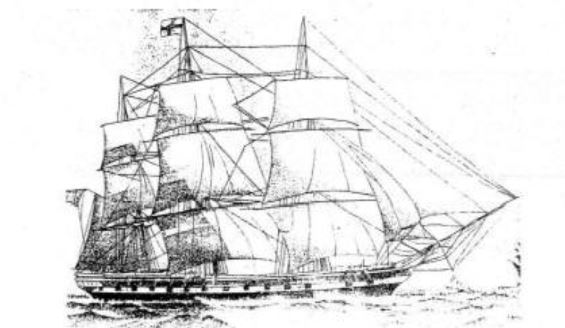
Duchess of Northumberland
Built 1834, 541 tons

I was able to find John arriving in the Colony of Port Phillip on 3 Jun 1841, as a bounty immigrant, aboard the Duchess of Northumberland , after a 107 day voyage from London via Plymouth. The Ship made history, as it carried the first mail and news from England to arrive direct to Port Phillip. Bounty Immigrants had their passage paid for them and a bounty was paid to the agent who had bought them out, but only after the immigrant had been interviewed by the Immigration Board on arrival, and deemed a suitable immigrant. A bounty, in John's case 19 pound, was paid to the agent, John Marshall. On the passenger list for the Duchess of Northumberland, John Myers(Mayers) was described as a 21 year old, Catholic, agricultural labourer from County Clare, who could both read and write. Of the 80 single males on board, 18 were from County Clare and only one of these was not a labourer, he was a carpenter. Four of the men were also accompanied by sisters. Although the steerage on the Duchess of Northumberland was described as lofty and roomy, with more than the 6 foot headroom required, it still lacked ventilation and became very stuffy on hot nights, with passengers often resorting to sleeping on deck. What tempted John to leave Clare and make this long perilous journey? 


Limerick Chronicle, 25 Jan 1840


Advertisements, like the one above from the Limerick Chronicle, 25 Jan 1840, appeared regularly in the newspapers and painted a glowing picture of Australia, at a time when the lower classes in County Clare were suffering. John was born about 1820. I have been unable to find a baptism, but, several siblings were baptised at St. Munchin's, Limerick City, a parish that straddled the Clare/Limerick border. He grew up in a time when land, food and employment were scarce for the landless labourers of Clare. In the fifty years prior to the Great Famine (1845-9), the population had doubled. The demand for Irish food had declined with the end of the Napoleonic War in 1815, so landlords began grazing cattle rather than growing crops, but continued to rent out land at the same high level the war had allowed. Landlords owned half the land in Clare, so with less cultivation, fewer labourers were needed, work became scarce and less demand for crops caused prices to fall and high rents couldn't be paid.  Potatoes, the staple food, were an unreliable crop, with partial failures in several years in the 1820's, that added to labourers' demise. This led to many violent uprisings against the landlords in the 1830's, the future looked bleak. Against this background is it any wonder that John thought he had a better future in Australia.


Melbourne c. 1840 from Surveyor-General's Yard by Robert Hoddle
State Library Victoria's Picture Collection


John arrived in Melbourne in 1841, only six years after it had been founded, the picture above gives an idea of what it was like then. I have found four mentions of a John Myers in early newspapers, but as another John Myers and family arrived in Melbourne in 1849, it is impossible to know who they refer to. However, they do give some insight into the colony at the time. A John Myers was fined on two occasions in 1849, firstly for cutting wood on crown land that wasn't included in his licence and the other for allowing five cattle to stray in the public thoroughfares of the city. The Sands & MacDougall Directory for 1860 lists a John Myers at 22 Little Lonsdale St West. There is a family story that a member of the family ran a hardware type business from a "tin shed" somewhere near where the Windsor Hotel is today. Could this have been it?

According to John's death certificate, he married in Melbourne to a Catherine Lahey(?) in 1857, but I have been unable to confirm this and there were no children. When he died in 1884, he left a will with his brother, Thomas, the sole beneficiary and executor. Thomas inherited 3 lots of land, the most substantial, 38 acres at Lakes Entrance, where John had resided until he came to Shepparton prior to his death. Perhaps the inheritance of this land at Lakes Entrance is the basis of another family story,  that Thomas wanted to move there, but his wife, Catherine considered it far to remote to do so and they remained in Shepparton. Despite John being quite specific about his land ownership at Lakes Entrance, Burn Brook and Wyndham and that the titles were with his solicitor in Melbourne, Thomas swore an affidavit for probate that only the title for the land at Lakes Entrance could be located, details of which were given in the Inventory for Probate and can be seen below. (Blocks 30A, 30D & 30E)


Department of Lands & Survey 1959, Parish of Colquhoun, County of Tambo
State Library Victoria


By coming to Port Phillip, John achieved land ownership, an impossibility for him in County Clare. He lived on a block of land at Lakes Entrance, perhaps drawn there by memories of home close to Limerick City, where the Shannon River meets the seawater of the Shannon Estuary. Finally a connection to a pioneer of Port Phillip.